
- Introduction
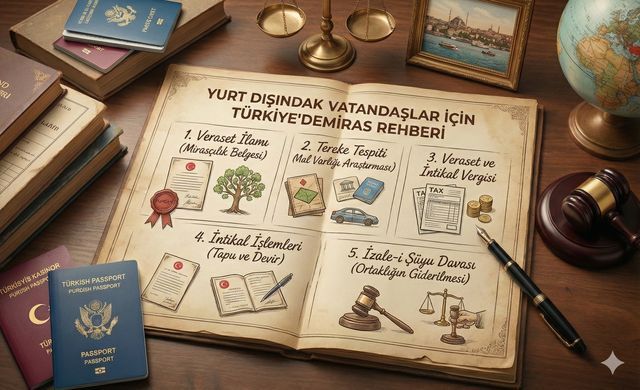
- 1. Documentation of Legal Heirship: The Certificate of Inheritance (Veraset İlamı)
- 2. Determination of the Estate (Tereke Tespiti)
- 3. Financial Obligation: Inheritance and Transfer Tax
- 4. Transfer Proceedings (Registration of Assets)
- 5. Disagreement Among Heirs: Dissolution of Partnership Lawsuit (İzale-i Şüyu)
Introduction
Turkish citizens or Blue Card holders residing abroad face various legal and bureaucratic processes when they inherit property in Turkey. Due to geographical distance, differences in legislation, and the complexity of bureaucratic procedures, these processes can sometimes appear challenging. However, the Turkish legal system allows inheritance procedures to be carried out without the heir needing to be present in Turkey. This article objectively outlines the necessary legal steps for the transfer of inheritance and situations that may be encountered.
1. Documentation of Legal Heirship: The Certificate of Inheritance (Veraset İlamı)
The first and fundamental step of the inheritance process is the official determination of who the legal heirs are and their respective shares in the inheritance. This document is called the “Certificate of Inheritance” (Mirasçılık Belgesi) or formerly known as “Veraset İlamı”.
- Legal Nature: It is an official decision showing the legal heirs of the deceased (the decedent) and their shares. Without this document, no transactions can be made at land registry offices, banks, or other official institutions.
- Method of Procurement: The Certificate of Inheritance can be obtained from notaries or Civil Courts of Peace in Turkey. If there is no confusion in the civil registry records, notaries can issue this document quickly.
- Remote Processing: Heirs living abroad do not have to come to Turkey to obtain this document. Through Turkish Consulates in their country of residence, they can procure this document via a special power of attorney given to a lawyer in Turkey.
2. Determination of the Estate (Tereke Tespiti)
After the certificate of inheritance is obtained, the next stage is to determine the assets and liabilities of the deceased’s estate (tereke). Heirs may not know the full details of the deceased’s assets.
In this context, the principal investigations that need to be conducted are:
- Land Registry Records: Querying all real estate (house, land, field, etc.) registered in the name of the deceased at land registry offices throughout Turkey.
- Financial Assets: Writing to banks to investigate the existence of deposit accounts, foreign currency, gold, or safe deposit boxes.
- Other Assets: Determining other officially registered assets such as vehicle registration records, company shares, or firearm licenses.
Performing this determination completely is important to prevent any loss of rights in the future.
3. Financial Obligation: Inheritance and Transfer Tax
According to Turkish tax legislation, persons who acquire property unrequitedly through inheritance are subject to Inheritance and Transfer Tax (Veraset ve İntikal Vergisi).
- Declaration Process: In order for the transfer of inherited property to be made, an Inheritance and Transfer Tax Declaration must first be submitted to the relevant tax office.
- Legal Deadlines: If the death occurred in Turkey and the heir is abroad, the deadline for submitting the declaration is generally 4 months from the date of death. If the death occurred abroad, these deadlines may vary. Failure to submit the declaration on time can lead to irregularity fines.
- Exemptions: Certain amounts determined by law are exempt from tax. The tax is calculated on the portion exceeding these exemption amounts, according to a progressive tariff.
4. Transfer Proceedings (Registration of Assets)
After the procedures with the tax office are completed and a “clearance certificate” is obtained, the stage of officially registering the inherited property in the name of the heirs (intikal) begins.
- Title Deed Transfer: By applying to the relevant land registry offices, the title deeds of real estate are registered in the name of the heirs according to the share ratios in the certificate of inheritance.
- Movable Assets: Transactions such as withdrawing money from banks or transferring vehicles are also carried out by applying to the relevant institutions.
All of these transactions can be carried out without the heir coming to Turkey, through a representative with appropriate authorization.
5. Disagreement Among Heirs: Dissolution of Partnership Lawsuit (İzale-i Şüyu)
A common situation in inheritance processes is the inability of heirs to agree on the sharing of inherited property. Disputes may arise regarding the sale or use of a real estate owned in shared ownership by multiple heirs.
According to the Turkish Civil Code, no one can be forced to continue shared ownership.
- Legal Solution: If any of the heirs (regardless of their share ratio) cannot reach an agreement with the other heirs, they can file a “Dissolution of Partnership Lawsuit” (İzale-i Şüyu) in the Civil Court of Peace.
- Legal Process: The court first invites the parties to agree. If there is no agreement and the physical division (partition in kind) of the property is not possible, the court decides to sell the property by public auction.
- Result: The proceeds from the sale, after deducting court costs, are distributed to the heirs in proportion to their shares. This lawsuit is the final legal solution path for deadlocked inheritance sharing.
Conclusion
Inheritance processes in Turkey involve a series of technical and legal procedures, from obtaining the certificate of inheritance to the tax declaration, from title deed transfer to potential litigation processes. It is recommended to receive professional support from lawyers expert in the field to carry out these processes, especially for persons living abroad, without suffering loss of rights and encountering penal sanctions.